Wednesday, December 07, 2005

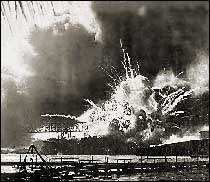
December 7th, 1941

Photo of the explosion of the U.S.S. Shaw, from the National Archives.

A strange Pearl Harbor conspiracy site. Here's another one.

1177 souls died aboard the USS Arizona.

Here is a list of those killed in the attack on Pearl Harbor, both civilian and military.

The attack on Pearl Harbor was a defining moment in America's history.

I just wanted to take a moment, and remind y'all it happened today, in 1941.

Update: Jim Macdonald has a terrific post and timeline, and quotes FDR's post-attack speech, over at Making Light. The conversation in the comments that follow his post is fascinating and illuminating.

Terrorism or Free Speech

This is why the Bush administration is so desperate to curtail civil liberties. From today's New York Times:

In bringing the case against Mr. Arian in 2003, the department relied on the easing of legal restrictions under the antiterrorism law known as the USA Patriot Act to present years of wiretaps on the defendants in a criminal context.

In the conversations cited by prosecutors, Mr. Arian was heard raising money for Palestinian causes, hailing recently completed attacks against Israel with associates overseas, calling suicide bombers "martyrs" and referring to Jews as "monkeys and swine" who would be "damned" by Allah.


There are things about our freedom of speech that I'm deeply uncomfortable with. I'm deeply uncomfortable with neo-nazi propaganda. I'm deeply uncomfortable with right-wing Christian condemnation of homosexuality.

What do you guys think? Here are some deeply, deeply disturbing links to aryan-power and neo-nazi sites. Don't click, if you're uncomfortable doing so. I read friggin' everything, and this stuff turns my stomach.

Have we passed the place in our cultural history where it is either necessary or wise to continue to allow this stuff? Does freedom of speech still have a place? Does it still need to apply to these extremes?

I would argue absolutely, yes. I'm curious, though, what y'all have to say about it.

Saturday, December 03, 2005

Tagged for a book meme

Tagged by Ray with another book meme--list 15 personal facts and/or preferences about books.

I can deal with book memes, so I'm happy to play.

Here we go:

1--Eudora Welty's prose is so delicious I love to read her aloud, to myself or to others--doesn't matter either way.

2--I actually love to read aloud just in general, now that I think of it. Some authors are better for it than others, though.

3--If I particularly love a book, I'll buy extra copies so I have copies to force on give away to friends and acquaintances

4--My favorite childhood books were The Black Stallion books, and The Happy Hollisters

5--I discovered spec-fic when I found a tattered paperback copy of A.E. Van Vogt's Slan in a box of old books in my dad's auto-shop waiting area--I was completely smitten and besotted with the genre, by the time I reached the end. I promptly read my way through Heinlein and Asimov, that same summer.

6--I wrote my master's thesis primarily on Stephen King's Pet Sematary--much to the bemusement and grudging admiration of my faculty advisor, department chair, and thesis committee. They liked it.

7--I'd rather read than watch anything on TV.

8--I usually have more than one book with me, everywhere I go.

9--I read as much or more nonfiction as fiction.

10--I can't go in a bookstore without buying a book. Or twelve.

11--I'm particularly addicted to How-To sorts of books: How To Tile Your Kitchen With Coconut Shells...How To Make Goat Cheese With An Oversized Tupperware and a Crock Pot...How To Raise Bees In Your Garage Without Being Stung to Death...

You get the idea, I'm sure.

12--I adore reference books. Especially books about words. The longer, more detailed the information, the better. Etymologies are soooooooo sexy...

13--I have too many books. I have books I literally haven't handled in years, but I cart them with me from place to place, whenever I move--and I can't bring myself to get rid of a single one of them.

14--I periodically reread much-loved books because the sense of familiarity is like catching up with a dear old friend. I have books I've read ten or more times.

15--I'm always a bit afraid, when I start a new book by an author I particularly like. I'm afraid this book will disappoint me. I'm afraid this book won't be as good as the author's others, and the let-down will taint the joy I feel when I get the next. It hardly ever happens that way. Still.

My god. Reading the above sounds downright...dysfunctional. Heh.

Okay, I'll tag Medievalist (on her blog of choice)--just leave us a link
Jen, on Creatif
Amy on Ruining My Eyes, if she happens to meander by
and Coyote Beta at Coyote Wild

(hint, hint: Someone should tag Frank, at Remaindered Random Musings
I would have, but I didn't wanna tag everyone I knew, so y'all could spread the love! *grin*)

Wednesday, November 30, 2005

"Once upon a time..."

I love those words. I have, for as long as I can remember. The promise of a story, offered to the listener, given weight by the gravity of ritual incantation.

So here is an autumn tale, just for you.

Once upon a time, far to the north, far from any wide blue ocean, there was a place where winter lasted much longer than it lasts now.

My family lived there on a farm, miles from the nearest town or village.

Nights turned cold after the garden was harvested and my mother had finished canning the apples, tomatoes, at least four kinds of pickles and the green beans; after the potatoes, onions, cabbages, and winter-squash were all stored safely away in the root-cellar; the peas, corn, and carrots bagged and stacked in the freezer.

Soon the frost would come every night, growing deeper and holding the land more firmly with every shortening day.

When the days turned cold enough that meat would keep well in the smoke-house, and the neighbor's wood-stove scented the cold air in the mornings, then it was time to butcher hogs.

My father would choose a morning and wake me long before daylight. I'd help him drive a couple of hogs up the livestock chute into the stock-rack on the truck, and we'd drive the few miles to the neighboring Hutterite colony. The defroster in the truck didn't work very efficiently, and my father would scrape a hole just big enough to see through in the the thick frost on the windshield. He'd drive with his head craned down to peer through the slowly widening clear spot.

When we got to the colony, my father would find one of the men, and together we'd unload the hogs into the holding pen. My part was really done, then. I'd wait shivering with the truck. Sometimes there was snow on the ground already. Usually, heavy frost rimed the branches of the cottonwoods, glittering in the headlights of the truck and light falling from the windows of nearby buildings.

In the frosty pre-dawn, the colony women in their long black dresses, with a bright, print aprons and head-scarves were already at work in the communal kitchens, baking bread for the day and preparing breakfast. One of them would bring me a smoking chunk of spicy homemade sausage wrapped in a warm breadroll, and a mug of cocoa. She'd offer it with a smile, and a glance at my father for his permission.

I'd stand in the pool of light from the big flood-lights on the barn, waiting. A small girl, seven or eight years old, munching soft bread soaking up hot fat from the sausage, sipping steaming cocoa.
Gradually, the sky would lighten to winter-gray. My feet so cold I couldn't feel them, by then, my father would finally come back with the men to load the carcasses--butchered, cleaned, bristles scraped. We'd drive home to breakfast, and my mother would spend the rest of the day cutting up meat. Over the next three or four days, the hams and bacons would be injected with brine and packed in sugar-cure. She'd carefully weigh the scraps and trimmings, season them, and grind the meat into sausage.

If you've never been inside a smokehouse--it's the most remarkable mix of salt, sweet, and smoke smells driven deep into the walls, season after season. Loops of sausage in natural casing, hams, and bacons hung to smoke slow, until they're all salty and pink; then all of it wrapped in heavy waxed brown paper and packed into the big chest-freezer on the back porch, stored against the long winter coming.

I don't know how to describe that feeling--the feeling of the winter's food stored against the coming dark and cold. It's not something people often experience during these days of fresh tomatoes and oranges, year-round. It seems very much to belong to a different place and time.

Once upon a time.

Monday, November 28, 2005

WalM*rt Christmas Riots

I've been bemusedly perusing the news reports of Black Friday brawls breaking out in the local Evil Empire Retailer Super-Centers.

The Free Republic reported:

In scenes reminiscient of the Great Depression, Americans lined up early this morning outside stores across the country as word of shortages of Christmas gifts caused riots when the stores opened.

With the price of gasoline and heating oil having hit record highs this year, consumers waited in the freezing cold to be first in line when the doors opened at 5 a.m. to buy laptop computers and other essentials before supplies were exhausted.

Riots at stores from Washington, D.C. to Washington state and as far south as Florida were reported. Shocked mothers complained their children were traumatized by the violence. Many expressed fears their children would be afraid to open their Christmas gifts for fear of causing a riot.


What on earth?

From a Yahoo News story: "Tempers flared at a Wal-Mart in Orlando, Fla., where a man allegedly cut in line to buy a bargain notebook computer and was wrestled to the ground, according to a video shown by an ABC affiliate, WFTV-TV."

Apparently, some folks are blaming this behavior on the Bush Economy.

"George Bush has never had to get up at three in the morning to wait in line for Wal-Mart to open so he could get a $400 laptop for his children," observed Robert Rubin, former Clinton administration Treasury secretary. "Bush's irresponsible tax cuts have hurt working families. I haven't seen lines like this since the breadlines of Republican Herbert Hoover's Great Depression. The shortages of Christmas gifts at this time of year shows how much Bush has squandered the Clinton legacy of sound economic policies."
Okay, you know what? This is just appallingly bad behavior, economy or no economy. These are not people trying to get a loaf of bread to take home to feed hungry kids. These shoving matches are over cheap laptops and plasma TV sets.

What in the name of all the little green gods has come over us, that we'd act like this?

What is so important to you that you'd publically brawl in the parking lot of the World's Largest Retailer, just so you didn't miss out on the one-day bargain price?

I honestly can't think of any single material thing that I value that much.


Thursday, November 24, 2005

The Holiday Season kicks off, TODAY!

HUZZAH!!!

And a very happy Thanksgiving, my friends, to you and yours.

Now I must go and cook stuff. *grin*

Tuesday, November 22, 2005

The Victorian era and my Varga-girl shirt...

My rather flippant comment about the Varga Girl shirt, at the end of my last post, led to an interesting response from Sour Duck--and a link to an excellent and thought-provoking article: "Vargas' Blonde Sambos".

Now, since I'm a sucker for links, and an even bigger sucker for googling, you can probably guess how I've spent the greater portion of the evening. Serendipitously, this all ties into the topic of how women are portrayed in the media--hence, circles right back to the deodorant-ad discussion.

Not that straying off-topic ever daunted me. Still, it's nice to at least pretend.

So come with me...this is interesting stuff.

Andrea Dworkin's article, "Vargas' Blonde Sambos", is fairly damning of the whole pin-up girl phenomenon--Varga Girls, in particular.

Among other things, she writes:

Vargas slimes women by trivialization or, perhaps more maliciously, by creating invisibility. The faces are all cosmetic, not a life line in them, the so-called women mostly blonde, with an emphasis in all the drawings on the breast or vaginal area. There are lots of bright red nails but no rib cages or muscles, no fat because there is no flesh; there are hard nipples, vacant smiles, painted toe nails, infantilization, hairless bodies; big eyebrows to designate the hairiness not seen; the blondes are good and childlike; the redheads are a little tougher; black hair is the sign of the wicked woman.
The drawings are propagandistic, fetishized "proto-porn", to Dworkin, and hardly even qualify as pop art.

My problem with this premise is that it takes as granted that pornography--or proto-porn, as the case may be--and art are mutually exclusive. I'm not convinced that's true. I'm also not convinced it is NOT true--but I'm not quite prepared to make it a gimme.

Ms. Dworkin also nearly ignores the historical, cultural, and artistic context of Alberto Vargas' work. Vargas' pin-ups follow a tradition of stylized--and yes, idealized--illustrations. I'm only going to drag you as far back in time as the end of the Victorian Era, and the famous Gibson Girls.

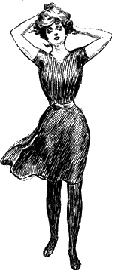
Everything you've heard about the Victorian era--the repressed sexuality, the strict adherence to conventions, the basements full of shocking sorts of sex-toys--lots of it's true, and probably more, besides. Charles Dana Gibson illustrated the end of this era, in the United States. Gibson also more-or-less defined the ideal picture of late-Victorian womanhood.
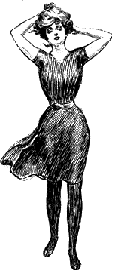
It's a picture American women have never quite escaped.

One writer (the article isn't bylined, or I would credit the author) explains:

'Many writers have attempted to describe the Gibson Girl, but Susan E. Meyer, in her book America's Great Illustrators did it best and most simply: "She was taller than the other women currently seen in the pages of magazines.. infinitely more spirited and independent, yet altogether feminine. She appeared in a stiff shirtwaist, her soft hair piled into a chignon, topped by a big plumed hat. Her flowing skirt was hiked up in back with just a hint of a bustle. She was poised and patrician. Though always well bred, there often lurked a flash of mischief in her eyes."'

Gibson Girls illustrated the idealized turn-of-the-century American woman, for better or worse.
Much changed with the end of the Victorian age. By 1930, America is in the middle of the Depression. We've seen the Great War. Prohibition is over, an abject failure. By the 1930s, one of Gibson's artistic successors was George Petty.


One biographical sketch of Petty notes:
After graduating from high school Petty travelled to Paris to study at the Académie Julian under Jean-Paul Laurens. Petty then returned to Chicago, working as a photo retoucher for a local printing company.

By the early 20's Petty was working as a freelance artist, painting calendar girls and covers for The Household magazine. It wasn't until 1926 that Petty opened his first studio in Chicago, by which time his client list had grown enormously.

"In 1933, the depths of the depression, Esquire Magazine was started. At a time when The Saturday Evening Post was a nickel, The Ladies Home Journal a dime, and Good Housekeeping and Cosmopolitan a quarter, Esquire debuted at 50 cents. Only Fortune, started in 1930, just three months after the stock market crash, was priced higher at $1. And just as Fortune had confounded the prophets by being successful, Esquire's first issue sold out - even with a print run of 100,000." (source page)

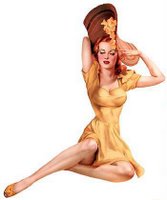
By the thirties, Petty was doing freelance adwork illustrations, and cartoons for Esquire. The Petty Girl first appeared in 1933. Here's an early example of Petty's airbrush work.

Cheap, easily-reproduced, color printing was something of a novelty in the early 20th century--the Chicago Trib finally went color in 1936. Esquire's pin-ups (and the calendars, etc) were inexpensive, full-color art for ordinary folks living through the depression. Since calendars and magazines still have to be purchased, the images were specifically aimed at men--because men were the ones who controlled money, for the most part.

This, finally, brings us to Alberto Vargas. Esquire hired him in 1940.

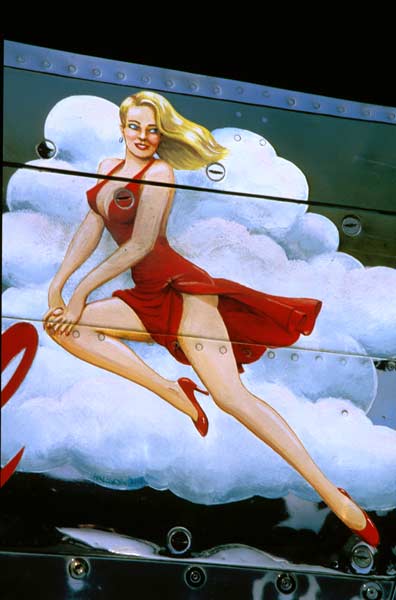
A year later, America entered World War II. The Varga Girl went, too. Airmen decorated their planes with imitations, like the Glamerous [sic] Gal P-51 Mustang, pictured below, on the left.
Soldiers and Seamen plastered their walls and bunks with pin-ups. Masturbatory fantasy material? Sure.
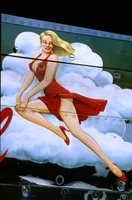
Proto-porn? Oh, hell--I dunno as you can even call it "proto"--Vargas did illustration work for Playboy, later on.

Is it art?

Maybe.

An essay by Maureen Honey, argues rather eloquently that it is:
Alberto Vargas did not create the relatively narrow parameters for women’s ideal role after the war. As a commercial artist trying to survive, he excelled at picking up on the mainstream cultural trends flowing around him, and he was able to combine his talent for erotic art with wartime forces placing the pin-up in a central location. To appreciate the skill with which he did this is not to approve of the images themselves, however, nor to dismiss as trivial the impact they had on popular culture. Women’s opportunities constricted after the war in large part because representations of female strength were overtaken by those of sexual objectification. It may be possible to combine women’s sexuality with nonracist egalitarian portraits of female accomplishment, but the end result of World War II was to divide these images into contestatory domains even as they met on the common ground of women’s maternal destiny. Perhaps there is something inherently sexist in warfare, especially when erotic frankness is paired with conservative family norms, but the Varga Girl serves as a reminder that cheesecake is not on the margins of culture but rather is as American as apple pie.


She's right, of course. But she fails to ask the question we must ask ourselves: Do we want to participate in perpetuating that image?

Where is the line between art and propaganda? Where does the kitschy pop-art appeal separate from the overt sexualization and objectification of women, and become just kitschy pop art? Does it ever?

I'll freely admit, I'm troubled not at all by the idea of pornography being art--at least sometimes.
However, I'm deeply troubled by the notion of my beautiful Hawaiian shirt as anti-woman propaganda.

Art is disturbingly powerful as a propaganda tool.
Sunday, November 20, 2005

Carnival of Feminists

The newest collection of excellent feminist blogging is out. Sour Duck hosts this round.

A really fascinating entry, over at Culture Cat, was this comparison of a 1973 deodorant ad with a 2005 ad. Fascinating and appalling.

Now, I will confess that I have a really stunning Varga-Girls-on-classic-cars Hawaiian shirt. A very cool designer friend of mine made it for me. I love that shirt.

I'm a chick, though, so it's okay, right?

Monday, November 14, 2005

I might as well warn you now...

The holidays are coming. I love the winter holidays, unabashedly. I'm sentimental and silly as a little kid about it, really.

Just so you have fair warning.

Thanksgiving is right around the corner, and I'm terribly excited. I walk around planning menus in my head. Not that I'm cooking for anyone. Still, one should give these things a great deal of thought.

Perhaps it will snow. *Happy thought!* Of course, it only snows about once every few years, here. Far more likely it will be partly cloudy, with highs in the 50s, and scattered showers.

That's okay. It will be Thanksgiving day. I will watch the Macy's parade, and cook delicious things for myself, and dig out the Christmas music, which will replace all the normal music in the house, until my housemates rebel outright.

And perhaps it will snow.

Wednesday, November 09, 2005

Democracy in Action!

So the Kansas School Board voted 6 to 4 in favor of including a prepared statement about Intelligent Design in high school biology classes. (A prepared statement? Perhaps to prevent those pesky science teachers from scoffing and jeering?)

Reporter John Hanna points out, in the linked AP article, "In addition, the board rewrote the definition of science, so that it is no longer limited to the search for natural explanations of phenomena."

In Kansas, "Science teachers will now be required to instruct their students that evolutionary theory is not proven, and will have to add that life is in fact so complex, it could not have arisen without the involvement of some external agent, or higher power."

At the same time, the Dover, PA trial winds up with closing statements: "lawyers for the defence argued that intelligent design is a 'legitimate educational objective', and described it as 'the next great paradigm shift in science'."

So what did the voters do in Pennsylvania, yesterday? They threw the bums out. All eight pro-ID Republicans were replaced by Dems who don't believe ID should be taught in schools.

Look, it boils down to this: I don't care if people believe in ID. They have no friggin' right to teach what they believe, their religion, to my kids--especially not using my tax-dollars to pay for it. They had to REWRITE THE DEFINITION OF SCIENCE to make it fly.

Guess we won't look for any great scientific minds to come out of Kansas.

Tuesday, November 01, 2005

On the Road...

Blogging this from the Dallas/Fort Worth airport, and my plane is boarding as I type. I'll be on the road for the next five days, so I don't know how much you'll be hearing from me this week.

I shall miss you all ferociously.

Thursday, October 27, 2005

What do Sarah Good, Rebecca Nurse, Susannah Martin, Elizabeth How, and Sarah Wilds have in common?


Give up?


They were hanged as witches in Salem on July 19th, 1692.

Now, let's look at just one of those names.

I give you Sarah Wilds. She was, by some accounts, a somewhat wild young woman. She'd been arrested twice for lewd behavior in the past.

One of those arrests was for wearing a bright scarf.

The Salem arrest warrant for Sarah (and others included in the same warrant) reads:
Salem Aprill the 21'th 1692

There Being Complaint this day made (before us) by Thomas putnam and John Buxton of Salem Village Yeomen, in behalfe of their Majest's for them selfes and also for severall of theire Neighbours, Against Wm Hobbs husbandman and Delive' his wife, Nehemiah Abot Jun'r weaver. Mary Easty the wife of Isaac Easty and Sarah. Wilds the wife of John Wilds all of the Towne of Topsfield. or Ipswitch and Edward Bushop husbandman & Sarah his wife of Salem Village, And Mary Black a negro of Leut Nath Putnams of Salem Village also And Mary English the wife of philip English Merchant in Salem for high Suspition of Sundry acts of Witchcraft done or Committed by them Lately upon the Bodys of Anna putnam & Marcy Lewis belonging to the famyly of the aboves'd Thomas putnam Complain't and Mary Walcot the daugter of Capt Jonat' Walcot of s'd Salem Village and others, whereby great hurt and dammage hath benne donne to the bodys of said persons above named therefore Craved Justice

High suspicion of sundry acts of witchraft.

That's terrifying stuff, if you live somewhere that is very dark indeed, when the sun sets. The devil might walk just out there, in the forest, just beyond the palisade that protects the village from wild animals and . . . other dangers.

The trial is shockingly brief. It consists of a flurry of exchanges that I'm tempted to paraphrase, just because it would sound so terribly ridiculous.
Here's the transcript:

Hath this woman hurt you?

Oh she is upon the beam.

Goody Bibber that never saw her before sayd she saw her now upon the beam, & then said Bibber fell into a fit

What say you to this are you guilty or not?

I am not guilty Sir.

Is this the woman? speaking to the afflict[ed]

Thay all, or most, said yes, & then fell into fits.

What do you say, are you guil[ty]

I thank God I am free.

Here is a clear evidence that [you have] been not only a Tormenter [but that] you have caused one to sig[ne the] book, the night before last [What] you say to this?

[I n]ever saw the book in my life [and I never] [saw these per]sons before

[Some of th]e afflicted fell into fits


- 807-

[Do] you deny this thing that is [torn]

All fell into fits, & con[firmed] that the accused hurt th[em]

Did you never consent that [these should] be hurt?

Never in my life.

She was charged by some [with] hurting John Herricks mo[ther]

The accused denyed it.

Capt How gave in a relation [and] confirmation of the charge before made.

She was ordered to be taken away, & they all cryed out she was upon the Beam, & fell into fits.


She was condemned, of course. Then she hung. Sarah, John's wife, with a daughter of her own. Sarah, who once wore a brightly-colored scarf. I wonder if she loved that scarf, loved the color of it.

I hope so.


Tuesday, October 25, 2005

Tagged

Coyote Wild tagged a handful of folks with the following meme, so here goes.


1. Take first five novels from your bookshelf.
2. Book 1 -- first sentence
3. Book 2 -- last sentence on page 50
4. Book 3 -- second sentence on page 100
5. Book 4 -- next to the last sentence on page 150
6. Book 5 -- final sentence of the book
7. Make the five sentences into a paragraph.
8. Feel free to "cheat" to make it a better paragraph.
9. Name your sources
10.Post to your blog.

Here's mine:

Nothing moved but the wind and only a few, last, lingering drops of rain, only a blowing of water off the ruined wall. Was it enough just to survive? They discussed the mystery while perambulating the sunken mounds of the settlement. Jonesy's wide gaze did not falter, but Horn saw that the skin around his eyes was drawn tight with tension. Then they walked down the steps and across the lawn side by side, Jonesy limping, Horn with the sleeping child in his arms, and for that moment the only darkness was their shadows trailing behind them on the grass.

From:
The Walking Drum by Louis L'Amour
The Shrinking Man by Richard Matheson
I Should Be Extremely Happy in Your Company by Brian Hall
Swordspoint by Ellen Kushner
Dreamcatcher by Stephen King

Why, no. I don't alphabetize, unless I'm procrastinating terribly...

Coyote also tagged Jason, at The Clarity of Night--he churned out a really creepy paragraph;
and Kira, at Loving Twilight--who posted a rather surreal paragraph. Kira then tagged Tish at love and sex and hope and dreams, Michelle at Random Thoughts, Chris at Skittermagoo, and Dawno at NVNC ID VIDES, NVNC NE VIDES.
Jason tagged Anne Frasier, Static (it's only fair)
Kara Alison, Mountaintop Architecture
Chemical Billy, Chemical Billy
Anne, Something Under the Bed is Drooling


Tag to ALL of you regulars, but especially Jill at Writes Like She Talks; Mark Pettus at The Bluff; .:J.r.A.:., at The Thought That Almost Was ; Joanne, at Writing After Dark; Jen, at Creatif; and Ms M, at PhDBlogIt (err--you did take novels with you, didn't you?)

*Grin* If you don't have your own blog, feel free to post it in the comments here. Post a link here, if you do have a blog, and choose to accept the assignment.

Saturday, October 22, 2005

Children Left Behind

An opinion piece in today's New York Times states:

The Bush administration responded characteristically this week when it put a positive gloss on national math and reading scores that were actually dismal - and bad news for the school reform effort. Faced with charges that his signature reform, the No Child Left Behind Act, was failing, the president played up the minor positive results. He should have seized the moment to acknowledge the bad news and explain what it would take to make things right.

He should also, of course, have reminded the nation that as long as it fails to take school reform seriously, American children will fall further and further behind their peers abroad.


Public Education just isn't one of those sexy issues. You know the issues I mean--the ones it's so much fun to get all worked up over and scream at each other: war, scandal, indictments, criminal neglect after hurricanes, and all manner of corruption and dirty deals.

In fact, instead of addressing our kids' crappy science scores, we're debating teaching the Intelligent Design speculation* in our science classes. Because what the heck? It's not like we're actually teaching science very successfully anyway, right?

"A 2004 study by the National Science Foundation found that the United States ranks 17th in the proportion of 18- to 24-year-olds earning science and engineering degrees, down from third place in 1975." (Houston Chronicle)

Ironically, Congress cut the National Science Foundation's budget in 2004.

Figures, huh? This is the same party that wants to yell about family values and prioritizing, yadda yadda yadda.

We better get our heads out of our asses pretty soon and start educating our children, though.

I was talking with friends who have a toddler. They've started the application process to get her into a good private school. Apparently, there's quite a waiting list. Also, it's quite expensive. It made me wonder what the heck happens to kids with parents who just can't afford to do that? They go to public school, of course. They get an education that might--if they're lucky, bright, and motivated--equip them to fill out W*l-M*rt applications.

For the record, I don't blame teachers for this situation. I think the whole system is broken. I think far too much of the money we spend on education gets syphoned off into administrative bureaucracy, and far too little gets spent on things like books, computers, and lab equipment.

Also for the record, I could care less whether people believe in a supreme being who designed the life with deliberate intent. I do think that supreme being might have put a bit more effort into designing more efficient backs for bipedal primates who walk upright. . .

Which only further reinforces that ugly gap between haves and have-nots, doesn't it? Right now, we're building what America will be for the next generation. Why, for heaven's sake, can't we just once show a little forethought?


*I refuse to refer to ID as a "theory" because, in fact, it is NOT a theory in the same sense and definition of the word as the theory of evolution. No amount of referring to it as such can make it so. The media has been treating the word as if it means the same thing when applied to either evolution or ID--which is either ignorant or intellectually dishonest, but certainly inaccurate and misleading.


Thursday, October 20, 2005

Orphan books: a shameless promotional pitch for someone else's writing

Here's a post from the Zack Company blog that's pretty educational for the writers out there.

Sometimes it happens that a book gets sold to a publisher, but then the editor leaves. That editor is the person who sold everyone else in the house on publishing that book. He or she is the champion and voice of that book. So when the editor leaves before the book goes into print, it can be devastating.

The Dead of Winter apparently lost both its editor and its publisher, and pretty much everyone else who was originally involved with the decision to publish the book. (Except, apparently, its dedicated agent.)

"...More than half a century after the last shots of World War II were fired, a team of forensic scientists and relic hunters enlisted the aid of several veterans of the Bulge for one last mission: to return to the battle site and recover the lost remains of their brothers-in-arms, to ensure they would be buried with all the honors they deserve. Written by a member of the expedition, this is a story of loyalty and the bonds of war, a compelling scientific mystery, and a long-awaited homecoming for families who waited decades for the return of their loved ones." (from the Amazon editorial review.)

I love WWII history stuff.
It also looks like a damned good book.
Andy Zack has been a seriously stand-up guy in terms of helping writers for free whenever and wherever he can. He blogs, and he answers questions on the Ask The Agent forum on AW. He doesn't ask for much in return.

Mostly, though, good books deserve to be read.

Here's an interesting thing...

So while cruising the blogosphere in avoidance of real work, I came upon this Ginmar post, linked at Philobiblon via Carnival of Feminists. Go read, or at least skim. I'll wait.

Ginmar quotes one of her posters as saying:
What you and other commenters have said about anger got me thinking. I'm not afraid to express my anger when provoked, but one thing I've noticed is that people often laugh.
Actually, I say people, but the faces that come to mind all belong to men. See, I go clubbing a lot because I enjoy dancing to loud music. What usually happens is that some idiot thinks that because my clothes are tight he can grab my ass. I turn and get angry. Invariably, these guys laugh at me and are all "what's the big deal?"
One particularly bad night I had been groped maybe ten times in under three hours. I was standing outside a club waiting to get in, feeling really on edge. Someone standing behind me grabs my ass. I whirl and almost punch the guy in the face before I realise I know him; he's a friend of a friend. I glare at him and say "that was not cool." He grins. I repeat, vehemently, "that was not cool." He says "aw, c'mon, I was just joking around!"


Now, I don't know if you read the comments following, or not, but what struck me most was that nearly every poster had a story about being touched, grabbed, groped, or otherwise man-handled--and laughed at when she objected. Both the offending groper and other men in the crowd laughed or otherwise dismissed her objections.

What really freaks me out is when other women participate in this bizarre and alarming attitude.
I remember one night an acquaintance's husband (who was a complete creep) grabbed my ass when we were all out at a bar together. I whirled around, planted the heel of my hand in his chest, and shoved hard. Then I told him off in no uncertain terms, and in pretty graphic language. I was furious.

He was indignant and offended. His wife was perplexed. She laughed and told me I was overreacting. Explained that, since I was a lesbian, I apparently just didn't understand that I should be pleased and flattered by the attention.

Yeah. She really said that.

Gag, retch, blech, ptoooie, ICK.

Now. At the time, I thought this was mostly about gender-preference. I was very young--mid-twenties--and self-absorbed. Largely, though, I interpreted both his and her actions as sexual aggression in response to my open lesbianism. The bigger picture was a lost on me. I did realize that I really didn't want to know anything more about the dynamics of their marriage. Whatever freaking kink they shared that made it okay for them to participate in molesting unwitting acquaintances in social situations was just too icky to contemplate.

Now I'm wondering, though--is this attitude something women do to other women on a regular basis? Is this something straight women do to lesbians, to keep us in line? Some of both? Because women participating in the subjection of other women happens a lot.

What's the social motivation for that? It cannot possibly be pleasant for a woman to go to a bar with her husband, for chrissakes, and defend his entitlement to grope other women.

In a sane world, she would have been as pissed at him as I was.

No. Scratch that. In a sane world, it would have never occured to the guy that it was in any way appropriate, acceptable, or otherwise okay to grab a woman's ass in public.

Tuesday, October 18, 2005

hmmmm...

I'm too sleepy to write anything political, or to think very hard about things controversial.

Instead, I'll share a realization I had the other day. Perhaps it's indicative of getting older, I don't know.

When I think back over romantic attachments in my past, the people I remember most fondly are seldom the ones I actually went to bed with. Rather, the almosts hold my memory: The single kisses, that for one reason or another never went any further; the flirtations, with the too-long eye-contact that never quite turned into anything. The potential interrupted. It's just irresistable.

I'm not sure what that says about me. Commitment-phobe, my ex would probably say. Heh.

How 'bout y'all?

Thursday, October 13, 2005

The trouble with thought crimes...

I remember when the first hate-crimes laws were proposed. I had a queasy feeling about it, even though I'm a member of one of the groups of people thought to benefit from such laws.
Now, as you can imagine, mine isn't a popular view with my gay and lesbian peers.

It seemed to me that attaching stiffer penalties to crimes based on motivation of the perpetrator created an uncomfortable dynamic, whereby we defined and assigned value to individuals based on their "otherness". My sister was bartending at the time--and it seemed horribly wrong that should she be assaulted and murdered in an alley some night upon leaving work, it could be prosecuted differently than if I were assaulted and murdered in the same alley, upon leaving a gay bar. It also seemed both rash and wrong to make the motive--the thought--part of the crime itself.

Hate crime legislation doesn't seem to have made much of a dent, at least not here from the front lines. We're trapped in a painful tension of valuing ourselves based on diversity--embracing our "otherness"--and being separated from the greater part of our own culture and society by that same difference. I deeply fear that every time we create some official means of separation, we only deepen that dichotomy.

It's still a pretty regular occurrence to hear of someone getting beat up coming out of the wrong bar. There's apparently been a new rash of cross-burnings in the midwest, lately, too.
Recently, someone vandalized a local African American couple's house, here in the Seattle suburbs. They spray-painted racial slurs, swastikas, and obscenities all over the exterior.
It turned out to be a couple of local teenagers. They confessed. You've got to wonder just where they learn this stuff, don't you. The local news team interviewed people. The neighbors all professed their shock and dismay. I'm sure most of them were sincere.

Unfortunately, there seem to be some unforseen consequences stemming from an attempt to prosecute ideology. In the hysteria following the 9-11 attack, we passed a bunch of terrorism and Homeland Security legislation--a natural progression of trying to sort crime by the thoughts and motives behind it. Now we've come to a place where nine United States Senators and the White House all think it's just fine to torture people--as long as we think they're terrorists. It's just fine to hold even American Citizens indefinitely and without charge--as long as we think they're terrorists.

We've long made distinctions that benefit someone who commits a crime, with mitigating circumstances, self-defense, and other grounds for leniency. Is that really intrinsically different than finding grounds for even stiffer penalties? I actually think it is. Recent emphasis and movements for victim's rights aside, I applaud compassion built into our laws for both the perpetrator and the victims, whenever possible. I remain distinctly uncomfortable by attempting to impose greater penalties by peering into the motives of the defendant.

Hobbit Bones

Wee little bones from wee little people, found in Indonesia. Perhaps there was a hobbit massacre, involving orcs and balrogs and evil wizards.

Wednesday, October 12, 2005

I had a lovely post all planned

Don't worry. I saved it. It can go up some other day.

Today, though, I wanted to direct your attention to Writes Like She Talks. Jill has been taking us through modern traditional observance of Yom Kippur, and writes about a version of a confessional prayer recently sent to her. She's posted this sensitive, incisive, and eloquent "Al Cheit"--called "If Dubya were a Jew, he'd be in trouble on Thursday."

See you there.