My rather flippant comment about the Varga Girl shirt, at the end of
my last post, led to an interesting
response from
Sour Duck--and a link to an excellent and thought-provoking article:
"Vargas' Blonde Sambos".
Now, since I'm a sucker for links, and an even bigger sucker for googling, you can probably guess how I've spent the greater portion of the evening. Serendipitously, this all ties into the topic of how women are portrayed in the media--hence, circles right back to the deodorant-ad discussion.
Not that straying off-topic ever daunted me. Still, it's nice to at least pretend.
So come with me...this is interesting stuff.
Andrea Dworkin's article,
"Vargas' Blonde Sambos", is fairly damning of the whole pin-up girl phenomenon--Varga Girls, in particular.
Among other things, she writes:
Vargas slimes women by trivialization or, perhaps more maliciously, by creating invisibility. The faces are all cosmetic, not a life line in them, the so-called women mostly blonde, with an emphasis in all the drawings on the breast or vaginal area. There are lots of bright red nails but no rib cages or muscles, no fat because there is no flesh; there are hard nipples, vacant smiles, painted toe nails, infantilization, hairless bodies; big eyebrows to designate the hairiness not seen; the blondes are good and childlike; the redheads are a little tougher; black hair is the sign of the wicked woman.
The drawings are propagandistic, fetishized "proto-porn", to Dworkin, and hardly even qualify as pop art.
My problem with this premise is that it takes as granted that pornography--or proto-porn, as the case may be--and art are mutually exclusive. I'm not convinced that's true. I'm also not convinced it is NOT true--but I'm not quite prepared to make it a gimme.
Ms. Dworkin also nearly ignores the historical, cultural, and artistic context of Alberto Vargas' work. Vargas' pin-ups follow a tradition of stylized--and yes, idealized--
illustrations. I'm only going to drag you as far
back in time as the end of the
Victorian Era, and the famous
Gibson Girls.
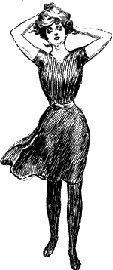
Everything you've heard about the Victorian era--the repressed sexuality, the strict adherence to conventions, the basements full of shocking sorts of sex-toys--lots of it's true, and probably more, besides. Charles Dana Gibson illustrated the end of this era, in the United States. Gibson also more-or-less defined the ideal picture of late-Victorian womanhood.
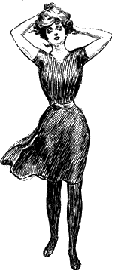
It's a picture American women have never quite escaped.
One writer (the article isn't bylined, or I would credit the author) explains:
'Many writers have attempted to describe the Gibson Girl, but Susan E. Meyer, in her book America's Great Illustrators did it best and most simply: "She was taller than the other women currently seen in the pages of magazines.. infinitely more spirited and independent, yet altogether feminine. She appeared in a stiff shirtwaist, her soft hair piled into a chignon, topped by a big plumed hat. Her flowing skirt was hiked up in back with just a hint of a bustle. She was poised and patrician. Though always well bred, there often lurked a flash of mischief in her eyes."'
Gibson Girls illustrated the idealized turn-of-the-century American woman, for better or worse.
Much changed with the end of the Victorian age. By 1930, America is in the middle of the Depression. We've seen the Great War. Prohibition is over, an abject failure. By the 1930s, one of Gibson's artistic successors was George Petty.
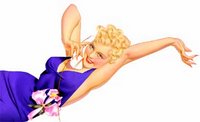
One
biographical sketch of Petty notes:
After graduating from high school Petty travelled to Paris to study at the Académie Julian under Jean-Paul Laurens. Petty then returned to Chicago, working as a photo retoucher for a local printing company. By the early 20's Petty was working as a freelance artist, painting calendar girls and covers for The Household magazine. It wasn't until 1926 that Petty opened his first studio in Chicago, by which time his client list had grown enormously.
"In 1933, the depths of the depression,
Esquire Magazine was started. At a time when
The Saturday Evening Post was a nickel,
The Ladies Home Journal a dime, and
Good Housekeeping and
Cosmopolitan a quarter,
Esquire debuted at 50 cents. Only
Fortune, started in 1930, just three months after the stock market crash, was priced higher at $1. And just as
Fortune had confounded the prophets by being successful,
Esquire's first issue sold out - even with a print run of 100,000." (
source page)
By the thirties, Petty was doing freelance adwork
illustrations, and cartoons for
Esquire. The
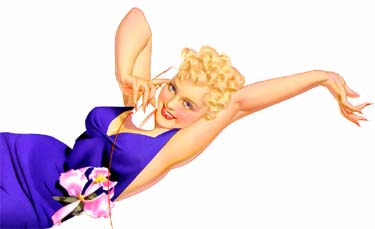
Petty Girl first appeared in 1933. Here's an
early example of Petty's airbrush work.
Cheap, easily-reproduced, color printing was something of a novelty in the early 20th century--the
Chicago Trib finally went color in 1936.
Esquire's pin-ups (and the calendars, etc) were inexpensive, full-color art for ordinary folks living through the depression. Since calendars and magazines still have to be purchased, the images were specifically aimed at men--because men were the ones who controlled money, for the most part.
This, finally, brings us to
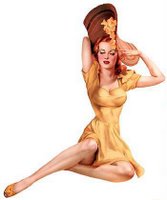
Alberto Vargas. Esquire hired him in 1940.
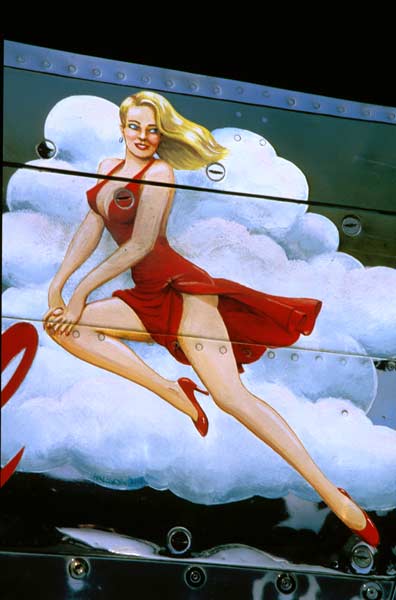
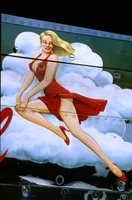
A year later, America entered World War II. The Varga Girl went, too. Airmen decorated their planes with imitations, like the
Glamerous [sic] Gal P-51 Mustang, pictured below, on the left.
Soldiers and Seamen plastered their walls and bunks with pin-ups. Masturbatory fantasy material? Sure.
Proto-porn? Oh, hell--I dunno as you can even call it "proto"--Vargas did illustration work for
Playboy, later on.
Is it art?
Maybe.
An essay by Maureen Honey, argues rather eloquently that it is:
Alberto Vargas did not create the relatively narrow parameters for women’s ideal role after the war. As a commercial artist trying to survive, he excelled at picking up on the mainstream cultural trends flowing around him, and he was able to combine his talent for erotic art with wartime forces placing the pin-up in a central location. To appreciate the skill with which he did this is not to approve of the images themselves, however, nor to dismiss as trivial the impact they had on popular culture. Women’s opportunities constricted after the war in large part because representations of female strength were overtaken by those of sexual objectification. It may be possible to combine women’s sexuality with nonracist egalitarian portraits of female accomplishment, but the end result of World War II was to divide these images into contestatory domains even as they met on the common ground of women’s maternal destiny. Perhaps there is something inherently sexist in warfare, especially when erotic frankness is paired with conservative family norms, but the Varga Girl serves as a reminder that cheesecake is not on the margins of culture but rather is as American as apple pie.
She's right, of course. But she fails to ask the question we must ask ourselves: Do we want to participate in perpetuating that image?
Where is the line between art and propaganda? Where does the kitschy pop-art appeal separate from the overt sexualization and objectification of women, and become just kitschy pop art? Does it ever?
I'll freely admit, I'm troubled not at all by the idea of pornography being art--at least sometimes.
However, I'm deeply troubled by the notion of my beautiful Hawaiian shirt as anti-woman propaganda.
Art is disturbingly powerful as a propaganda tool.


 I've boarded a long time. I'm definitely not Olympic class, and never was. When I started, it was damned hard to find ski areas that even let boarders ride the chairs up the mountain. We perversely took pride in that.